一、开始
上篇文章介绍了@babel/core,这次分析下@babel/parser。
@babel/parser主要可分为词法分析和语法分析两大部分,我们来看下二者都是如何运作、如何结合的。
二、API说明
babel之前的版本是直接调用了recast库,来生成的AST。现在的@babel/parser很大程度借鉴了acorn。
看源码之前可以先看文档,对它的功能、API有基本认识。
@babel/parser对外主要暴露了parse和parseExpression两个API,形式为:
babelParser.parse(code, [options])看下options中的sourceType参数,其值可以是script、module、unambiguous,默认是script。
如果是unambiguous的话会根据代码中是否出现import/export关键词来判断sourceType,如果出现了import/export则将sourceType更新为module,否则为script。
三、源码分析
本次分析的@babel/parser的版本是v7.16.4。
1. 目录结构
先看下它的目录结构:
- parser
  - base
  - comment
  - error
  - expression
  - index
  - lval
  - node
  - statement
- plugins
  - flow
  - jsx
  - typescript
- tokenizer
  - context
  - index
  - state
- utils
  - identifier
  - location
  - scope
- index可以看出它主要包含3个部分:tokenizer、plugins、parser。其中
tokenizer用来解析获取Token,包括state和context;parser包含node、statement、expression等;plugins则是用来帮助解析ts、jsx等语法的。
从index.js看起,当调用parser.parse方法后,会实例化一个Parser,就是上面parser/index.js文件中的Parser。Parser的实现很有意思,它有一长串的继承链:
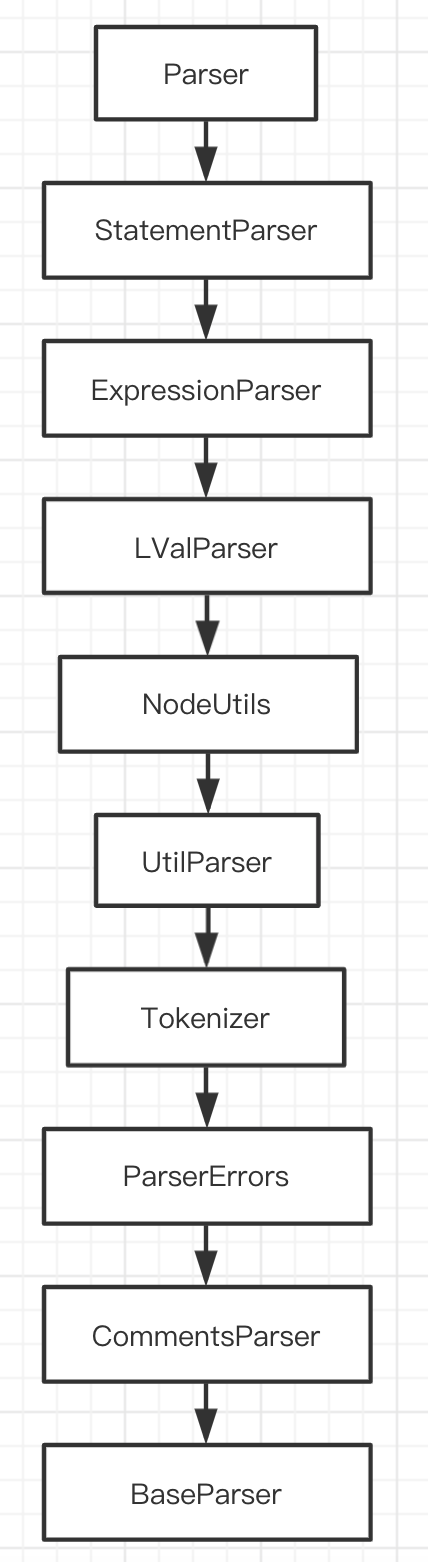
为什么要用这种方式组织代码呢?这种继承链的好处是只需要调用this就可以获取到其他对象的方法, 而且可以维护一份共同的数据,或者说状态,比如Node节点、state状态、context上下文、scope作用域等。
2. 运行机制
下面以一个极简单的例子来说明parser的运行机制:
const { parse } = require('@babel/parser')

parse('const a = 1', {})调用@babel/parser的parse方法的时候,会先通过getParser实例化一个Parser,然后调用Parser上面的parse方法。
function getParser(options: ?Options, input: string): Parser {
  let cls = Parser;
  if (options?.plugins) {
    validatePlugins(options.plugins);
    cls = getParserClass(options.plugins);
  }

  return new cls(options, input);
}由于Parser的继承关系,在实例化的时候会在各个类中进行一系列初始化操作,包括state、scope和context等。
然后进入parse方法,主要逻辑包括:
- 进入初始化的作用域
- 通过
startNode创建File节点和Program节点 - 通过
nextToken去获取一个token - 通过
parseTopLevel递归去解析。
export default class Parser extends StatementParser {
  parse(): File {
    this.enterInitialScopes();
    const file = this.startNode();
    const program = this.startNode();
    this.nextToken();
    file.errors = null;
    this.parseTopLevel(file, program);
    file.errors = this.state.errors;
    return file;
  }
}startNode在NodeUtil这个类中,就是新建了一个Node,为什么掉用两次startNode呢,因为AST的顶层Node是File类型,其有一个属性program,需要新建另一个Node,这两个Node的start、loc信息一样。
export class NodeUtils extends UtilParser {
 startNode<T: NodeType>(): T {
    return new Node(this, this.state.start, this.state.startLoc);
  }
}进入nextToken,其在Tokenizer中,主要逻辑是判断当前位置是否已经大于输入的长度,如果是的话,调用finishToken去结束token,否则调用getTokenFromCode或者readTmplToken,去从code中读取token。
这里的ct.template就是以反引号开头,我们的例子是const a = 1,会走到getTokenFromCode。
this.codePointAtPos(this.state.pos)会获取当前字符,我们的例子中是c。
export default class Tokenizer extends ParserErrors {
 nextToken(): void {
    const curContext = this.curContext();
    if (!curContext.preserveSpace) this.skipSpace();
    this.state.start = this.state.pos;
    if (!this.isLookahead) this.state.startLoc = this.state.curPosition();
    if (this.state.pos >= this.length) {
      this.finishToken(tt.eof);
      return;
    }

    if (curContext === ct.template) {
      this.readTmplToken();
    } else {
      this.getTokenFromCode(this.codePointAtPos(this.state.pos));
    }
  }
}getTokenFromCode会对传入的code做判断,是否是点号、左右括号、逗号、数字等,我们的例子中会走到default,调用isIdentifierStart判断是否是标志符的开始,是的话调用readWord读取一个完整的token。
getTokenFromCode(code: number): void {
  switch (code) {
    // The interpretation of a dot depends on whether it is followed
    // by a digit or another two dots.

    case charCodes.dot:
      this.readToken_dot();
      return;

    // Punctuation tokens.
    case charCodes.leftParenthesis:
      ++this.state.pos;
      this.finishToken(tt.parenL);
      return;
    case charCodes.rightParenthesis:
      ++this.state.pos;
      this.finishToken(tt.parenR);
      return;
    case charCodes.semicolon:
      ++this.state.pos;
      this.finishToken(tt.semi);
      return;
    case charCodes.comma:
      ++this.state.pos;
      this.finishToken(tt.comma);
      return;
    // ...

    default:
      if (isIdentifierStart(code)) {
        this.readWord(code);
        return;
      }
  }
}isIdentifierStart的核心就是对字符的unicode编码做判断:
- 如果
code编码小于大写的A的编码(65),只有code是$符号才为true - 如果
code编码介于A-Z之间(65-90),则为true - 如果
code编码在大写Z和小写的a之间(91-96),只有code是下划线_才会true - 如果
code编码介于a-z之间(97-122),则为true - 如果
code编码小于65535,且大于170,并且不以特殊的ASCII字符开头才为true - 如果
code编码大于65535,通过isInAstralSet判断是否是合法标志符
export function isIdentifierStart(code: number): boolean {
  if (code < charCodes.uppercaseA) return code === charCodes.dollarSign;
  if (code <= charCodes.uppercaseZ) return true;
  if (code < charCodes.lowercaseA) return code === charCodes.underscore;
  if (code <= charCodes.lowercaseZ) return true;
  if (code <= 0xffff) {
    return (
      code >= 0xaa && nonASCIIidentifierStart.test(String.fromCharCode(code))
    );
  }
  return isInAstralSet(code, astralIdentifierStartCodes);
}在这里我们的c可以作为标志符开头,进入readWord。
readWord还是在Tokenizer中,作用是读取一个完整的关键字或者标志符。
它首先调用了readWord1,readWord1则会通过isIdentifierChar判断当前字符是否可以做标志符,来给它的位置pos加1,也就是向后移动。
我们的例子中,ch为const的下一个空格的时候会跳出循环,此时state.pos为5,得到的word为const。
然后判断word的类型,是否是关键字。keywordTypes是一个Map,其key是各种关键字或者符号等,value是一个数字。这里const属于关键字,其对应的value是67,也就是type为67。然后调用tokenLabelName。
tokenLabelName会根据type获取token对应的标签,const对应的标签是_const。
这里顺便看一下word不是关键字的逻辑,readWord会把word当作用户的自定义变量,比如例子中的a。
// Read an identifier or keyword token. Will check for reserved
// words when necessary.
readWord(firstCode: number | void): void {
  const word = this.readWord1(firstCode);
  const type = keywordTypes.get(word);
  if (type !== undefined) {
    // We don't use word as state.value here because word is a dynamic string
    // while token label is a shared constant string
    this.finishToken(type, tokenLabelName(type));
  } else {
    this.finishToken(tt.name, word);
  }
}

readWord1(firstCode: number | void): string {
  this.state.containsEsc = false;
  let word = "";
  const start = this.state.pos;
  let chunkStart = this.state.pos;
  if (firstCode !== undefined) {
    this.state.pos += firstCode <= 0xffff ? 1 : 2;
  }

  while (this.state.pos < this.length) {
    const ch = this.codePointAtPos(this.state.pos);
    if (isIdentifierChar(ch)) {
      this.state.pos += ch <= 0xffff ? 1 : 2;
    } else if (ch === charCodes.backslash) {
      this.state.containsEsc = true;

      word += this.input.slice(chunkStart, this.state.pos);
      const escStart = this.state.pos;
      const identifierCheck =
        this.state.pos === start ? isIdentifierStart : isIdentifierChar;

      if (this.input.charCodeAt(++this.state.pos) !== charCodes.lowercaseU) {
        this.raise(this.state.pos, Errors.MissingUnicodeEscape);
        chunkStart = this.state.pos - 1;
        continue;
      }

      ++this.state.pos;
      const esc = this.readCodePoint(true);
      if (esc !== null) {
        if (!identifierCheck(esc)) {
          this.raise(escStart, Errors.EscapedCharNotAnIdentifier);
        }

        word += String.fromCodePoint(esc);
      }
      chunkStart = this.state.pos;
    } else {
      break;
    }
  }
  return word + this.input.slice(chunkStart, this.state.pos);
}接着进入finishToken。
finishToken就是设置end、type、value属性,因为此时已经读取了一个完整的token,可以获取到它的结束位置、类型和真正的值了。
finishToken(type: TokenType, val: any): void {
  this.state.end = this.state.pos;
  const prevType = this.state.type;
  this.state.type = type;
  this.state.value = val;

  if (!this.isLookahead) {
    this.state.endLoc = this.state.curPosition();
    this.updateContext(prevType);
  }
}回到Parser的parse方法,之后会进入
- parseTopLevel =>
- parseProgram =>
- parseBlockBody =>
- parseBlockOrModuleBlockBody =>
- parseStatement =>
- parseStatementContent,也就是解析语句。
parseBlockOrModuleBlockBody(
  body: N.Statement[],
  directives: ?(N.Directive[]),
  topLevel: boolean,
  end: TokenType,
  afterBlockParse?: (hasStrictModeDirective: boolean) => void,
): void {
  const oldStrict = this.state.strict;
  let hasStrictModeDirective = false;
  let parsedNonDirective = false;

  while (!this.match(end)) {
    const stmt = this.parseStatement(null, topLevel);

    if (directives && !parsedNonDirective) {
      if (this.isValidDirective(stmt)) {
        const directive = this.stmtToDirective(stmt);
        directives.push(directive);

        if (
          !hasStrictModeDirective &&
          directive.value.value === "use strict"
        ) {
          hasStrictModeDirective = true;
          this.setStrict(true);
        }

        continue;
      }
      parsedNonDirective = true;
      // clear strict errors since the strict mode will not change within the block
      this.state.strictErrors.clear();
    }
    body.push(stmt);
  }

  if (afterBlockParse) {
    afterBlockParse.call(this, hasStrictModeDirective);
  }

  if (!oldStrict) {
    this.setStrict(false);
  }

  this.next();
}parseStatementContent根据startType类型解析不同的声明,比如function/do/while/break等,这里是const,会进入parseVarStatement。
export default class StatementParser extends ExpressionParser {
  parseStatement(context: ?string, topLevel?: boolean): N.Statement {
    if (this.match(tt.at)) {
      this.parseDecorators(true);
    }
    return this.parseStatementContent(context, topLevel);
  }

  parseStatementContent(context: ?string, topLevel: ?boolean): N.Statement {
    let starttype = this.state.type;
    const node = this.startNode();
    let kind;

    if (this.isLet(context)) {
      starttype = tt._var;
      kind = "let";
    }

    // Most types of statements are recognized by the keyword they
    // start with. Many are trivial to parse, some require a bit of
    // complexity.

    switch (starttype) {
      case tt._break:
        return this.parseBreakContinueStatement(node, /* isBreak */ true);
      case tt._continue:
        return this.parseBreakContinueStatement(node, /* isBreak */ false);
      case tt._debugger:
        return this.parseDebuggerStatement(node);
      case tt._do:
        return this.parseDoStatement(node);
      case tt._for:
        return this.parseForStatement(node);
      case tt._function:
        // ...
      case tt._const:
      case tt._var:
        kind = kind || this.state.value;
        if (context && kind !== "var") {
          this.raise(this.state.start, Errors.UnexpectedLexicalDeclaration);
        }
        return this.parseVarStatement(node, kind);
      // ...
    }
  }

  parseVarStatement(
    node: N.VariableDeclaration,
    kind: "var" | "let" | "const",
  ): N.VariableDeclaration {
    this.next();
    this.parseVar(node, false, kind);
    this.semicolon();
    return this.finishNode(node, "VariableDeclaration");
  }
}parseVarStatement又会调用next => nextToken,去解析下一个token,这个例子中是a。
next(): void {
  this.checkKeywordEscapes();
  if (this.options.tokens) {
    this.pushToken(new Token(this.state));
  }

  this.state.lastTokEnd = this.state.end;
  this.state.lastTokStart = this.state.start;
  this.state.lastTokEndLoc = this.state.endLoc;
  this.state.lastTokStartLoc = this.state.startLoc;
  this.nextToken();
}parseVarStatement之后会进入parseVar,parseVar会新建一个node,作为var声明,然后调用eat.
parseVar(
  node: N.VariableDeclaration,
  isFor: boolean,
  kind: "var" | "let" | "const",
): N.VariableDeclaration {
  const declarations = (node.declarations = []);
  const isTypescript = this.hasPlugin("typescript");
  node.kind = kind;
  for (;;) {
    const decl = this.startNode();
    this.parseVarId(decl, kind);
    if (this.eat(tt.eq)) {
      decl.init = isFor
        ? this.parseMaybeAssignDisallowIn()
        : this.parseMaybeAssignAllowIn();
    } else {
      if (
        kind === "const" &&
        !(this.match(tt._in) || this.isContextual(tt._of))
      ) {
        // `const` with no initializer is allowed in TypeScript.
        // It could be a declaration like `const x: number;`.
        if (!isTypescript) {
          this.raise(
            this.state.lastTokEnd,
            Errors.DeclarationMissingInitializer,
            "Const declarations",
          );
        }
      } else if (
        decl.id.type !== "Identifier" &&
        !(isFor && (this.match(tt._in) || this.isContextual(tt._of)))
      ) {
        this.raise(
          this.state.lastTokEnd,
          Errors.DeclarationMissingInitializer,
          "Complex binding patterns",
        );
      }
      decl.init = null;
    }
    declarations.push(this.finishNode(decl, "VariableDeclarator"));
    if (!this.eat(tt.comma)) break;
  }
  return node;
}eat方法在Tokenizer中,这里会调用next => nextToken => getTokenFromCode => ReadNumber,解析下一个字符也就是1。然后返回true,进入parseMaybeAssignDisallowIn。
parseMaybeAssignDisallowIn这里不再展开了,最后会得到一个type为NumericLiteral类型的Node的节点,并赋值给dcl.init。
之后在parseVar中调用declarations.push(this.finishNode(decl, "VariableDeclarator")),结束VariableDeclarator这个Node的解析。
eat(type: TokenType): boolean {
  if (this.match(type)) {
    this.next();
    return true;
  } else {
    return false;
  }
}回到parseVarStatement中,最后调用this.finishNode(node, "VariableDeclaration")结束VariableDeclaration这个Node的解析。
回到parseBlockOrModuleBlockBody中,smt解析完后会放到body中,然后再次调用next => nextToken,这次state.pos为11,this.length也是11,会调用finishToken(tt.eof)。
回到parseProgram中,调用finishNode(program, "Program"),结束program的解析。
再回到parseTopLevel中,调用this.finishNode(file, "File"),结束File的解析。
nextToken(): void {
  const curContext = this.curContext();
  if (!curContext.preserveSpace) this.skipSpace();
  this.state.start = this.state.pos;
  if (!this.isLookahead) this.state.startLoc = this.state.curPosition();
  if (this.state.pos >= this.length) {
    this.finishToken(tt.eof);
    return;
  }

  if (curContext === ct.template) {
    this.readTmplToken();
  } else {
    this.getTokenFromCode(this.codePointAtPos(this.state.pos));
  }
}总结下@babel/parser对const a = 1的解析主流程:
- 新建
File类型的Node,暂命名为NodeA; - 新建
Program类型的Node,命名为NodeB; - 解析
token,获取const; - 进入
parser,进入parseVarStatement,新建VariableDeclaration的Node,命名为NodeC; - 调用
next再解析一个token,得到a; - 进入
parseVar,新建VariableDeclarator的Node,命名为NodeD; - 调用
eat,因为下一个字符为=,继续调用next,解析下一个字符1; - 进入
parseMaybeAssignDisallowIn获取NumericLiteral类型的Node,命名为NodeE; - 将
NodeE赋值给NodeD的init属性; - 将
NodeD赋值给NodeC的declarations属性; - 将
NodeC赋值给NodeB的body属性; - 将
NodeB赋值给NodeA的program属性; - 返回
File类型的Node节点。
下面贴一下const a = 1这个简单例子的AST(省略了loc/errors/comments等属性),也可以去AST Explorer这个网站查看。
{
  "type": "File",
  "start": 0,
  "end": 11,
  "program": {
    "type": "Program",
    "start": 0,
    "end": 11,
    "sourceType": "module",
    "interpreter": null,
    "body": [
      {
        "type": "VariableDeclaration",
        "start": 0,
        "end": 11,
        "declarations": [
          {
            "type": "VariableDeclarator",
            "start": 6,
            "end": 11,
            "id": {
              "type": "Identifier",
              "start": 6,
              "end": 7,
              "name": "a"
            },
            "init": {
              "type": "NumericLiteral",
              "start": 10,
              "end": 11,
              "extra": {
                "rawValue": 1,
                "raw": "1"
              },
              "value": 1
            }
          }
        ],
        "kind": "const"
      }
    ],
  },
}
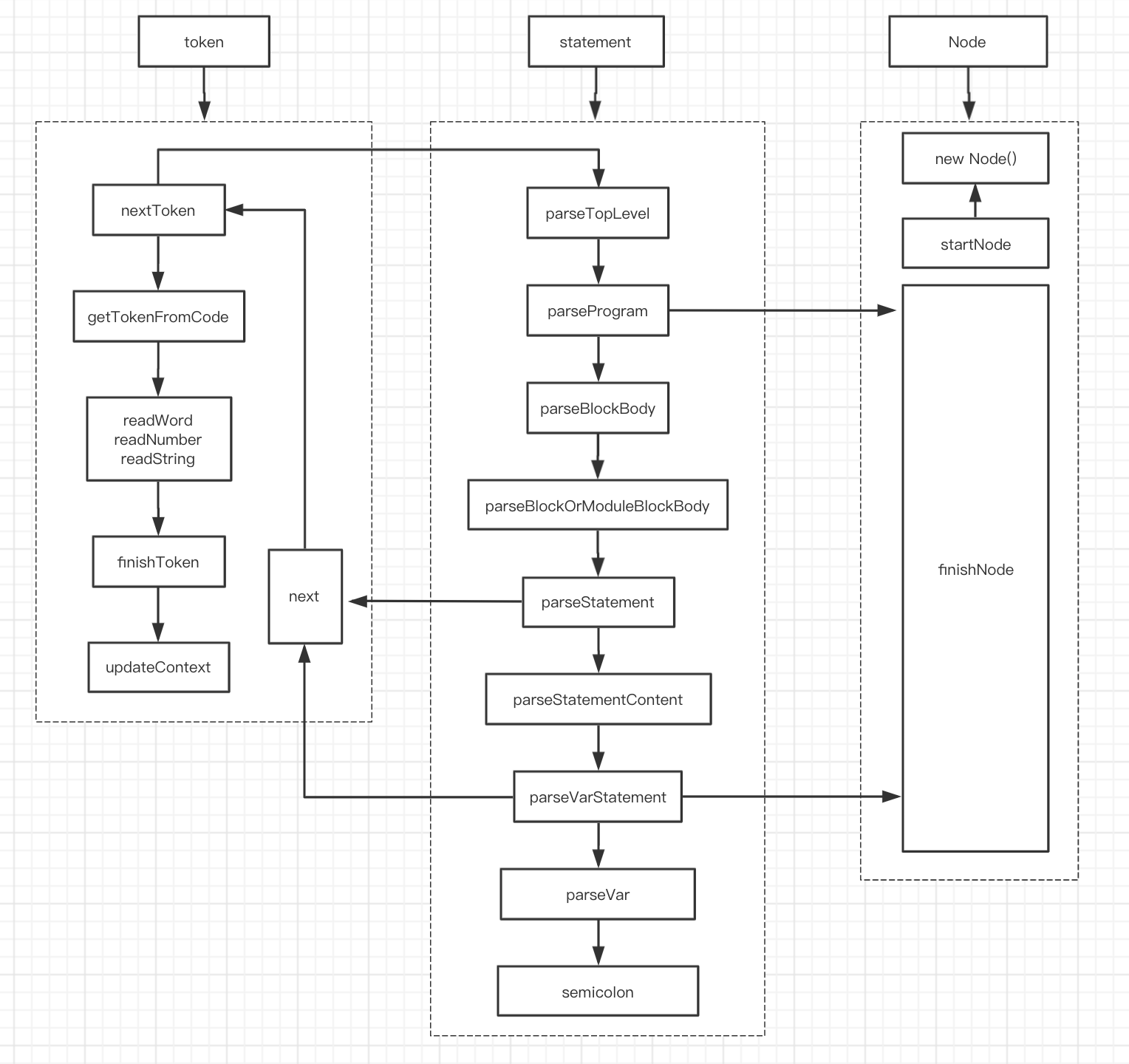
3. 流程图
下面是一张流程图,方便加深理解。
五、总结
通过上面这个例子,可以看出:
- 词法的解析和语法的解析,并不像许多文章中说的那样泾渭分明,不是先整体解析成
token、再将token解析成AST,而是获得第一个token后就进行词法解析,也就是说会同时维护Node和Token。解析过程中,会不断地通过nextToken方法获取下一个Token。 startNode、finishNode,startToken、finishToken是成对存在的,可以理解为栈或洋葱模型。进入一个Node,最后一定会通过finishNode对type/end等属性进行赋值,token也是一样。
本文主要起抛砖引玉作用。对@babel/parser感兴趣的同学,建议深入阅读源码,如果有疑问,欢迎探讨。
六、系列文章
- Babel基础
- Babel源码解析之@babel/core
- Babel源码解析之@babel/parser
- Babel源码解析之@babel/traverse
- Babel源码解析之@babel/generator